Image Source: i.sstatic.net
A Complete Explanation of How Gymnastics Is Scored
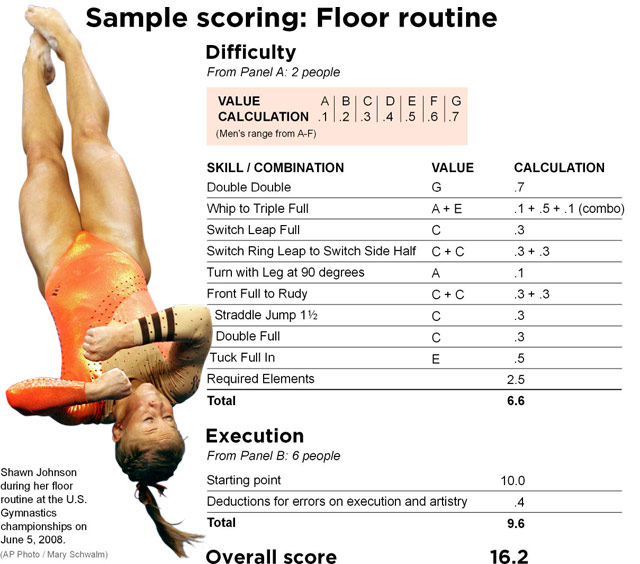
Many people ask, “How is gymnastics scored?” In artistic gymnastics, a gymnast’s final score comes from two parts: a Difficulty Score (D-score) and an Execution Score (E-score). Judges look at both how hard the routine is and how well it is performed to give these scores. The final score is simply the D-score added to the E-score, with any extra penalties taken off. Let’s look at how these parts work.
The Two Main Parts of the Score
Think of a gymnastics score as two main building blocks. You have one block for how difficult the moves are. This is the Difficulty score gymnastics, or D-score. You have another block for how perfectly the gymnast does the moves. This is the Execution score gymnastics, or E-score. You add these two blocks together to get the total score for the routine.
Deciphering the Difficulty Score (D-Score)
The Difficulty Score shows how hard a gymnast’s routine is. It measures the value of the skills shown and how they are connected.
How the D-Score Starts
The D-score does not start at zero or ten. It starts at zero and builds up. A gymnast earns points for every difficult skill they do well.
Points for Skills
Each gymnastics skill has a value. These values are set in a rulebook called the FIG Code of Points. The FIG is the group that runs gymnastics around the world.
Skills are rated by letters from A to G and even higher now.
* A is the easiest skill. It is worth 0.1 points.
* B is a bit harder. It is worth 0.2 points.
* C is harder. It is worth 0.3 points.
* D is harder. It is worth 0.4 points.
* E is harder. It is worth 0.5 points.
* F is harder. It is worth 0.6 points.
* G is very hard. It is worth 0.7 points.
* Skills even harder than G get even more points.
Table: Skill Values
| Skill Letter | Point Value | Difficulty Level |
|---|---|---|
| A | 0.1 | Basic |
| B | 0.2 | Beginner |
| C | 0.3 | Medium |
| D | 0.4 | Advanced |
| E | 0.5 | Expert |
| F | 0.6 | Elite |
| G | 0.7 | Very High Elite |
| H and above | 0.8+ | World Class |
The D-score judges watch the routine and write down every skill the gymnast does. They look up the value of each skill in the FIG Code of Points.
Counting the Skills for the D-Score
For most events, like Floor Exercise, Balance Beam, Uneven Bars, and Parallel Bars, only the gymnast’s 8 hardest skills count towards the D-score. For events like Vault and Pommel Horse, it works a little differently.
- Floor Exercise: 8 hardest skills.
- Balance Beam: 8 hardest skills.
- Uneven Bars: 8 hardest skills.
- Parallel Bars: 8 hardest skills (for men).
- Horizontal Bar: 8 hardest skills (for men).
- Rings: 8 hardest skills (for men).
- Pommel Horse: This is more about the total difficulty of linked moves, not just 8 single skills. Judges count the difficulty of different parts of the routine.
- Vault: The score comes from the specific vault the gymnast does. Each vault in the Code of Points has a set D-score value. If they do a Yurchenko double twist, it has a set D-score. If they do a harder vault, like a Cheng, it has a higher set D-score. Judges check that the vault is done correctly.
Adding Connection Bonuses
Gymnasts can get extra points in their D-score by connecting difficult skills right after each other without stopping or putting extra steps in between. This shows great control and skill.
- Connecting two D skills might add 0.1 points.
- Connecting an E skill and a D skill might add 0.2 points.
- Connecting even harder skills can add more points.
These connection bonuses are very important for getting a high D-score. The FIG Code of Points lists which connections give bonuses.
Meeting Routine Requirements
Besides doing hard skills, gymnasts must also meet Routine requirements gymnastics. These are certain types of moves or skills that must be in the routine. Each event has different requirements.
- Floor Exercise: Must have tumbling passes, dance elements, and a certain number of turns and leaps.
- Balance Beam: Must have turns, leaps, and acrobatic moves (like flips and aerials). They must also do a mount and dismount.
- Uneven Bars: Must have circling moves (like giants), release moves (where they let go of the bar and catch it again), and changes between the high and low bar.
- Vault: Must perform a vault from the list in the Code of Points.
- Men’s events: Pommel Horse needs circles, flairs, and travels. Rings need strength and swing moves. Parallel Bars need swings and releases. Horizontal Bar needs giant swings, release moves, and different grips.
If a gymnast misses a requirement, points are taken off the D-score. Each missed requirement costs 0.5 points. These are like penalties for not having a complete routine as required by the Gymnastics scoring rules.
The D-Score Judging Panel
There is a special group of judges who focus only on the D-score. This is part of the Gymnastics judging panel. They are called the D-judges or difficulty judges. They watch the routine and write down every skill. They check that the Routine requirements gymnastics are met. They calculate the value of the top 8 skills (or the specific event requirements) and add any connection bonuses. They also take away points for missed requirements. The average of the D-judges’ scores becomes the final D-score for that gymnast.
Grasping the Execution Score (E-Score)
The Execution Score shows how cleanly and perfectly a gymnast performs their routine. This is where they get points taken off for mistakes.
How the E-Score Starts
Unlike the D-score that builds up, the E-score starts perfect. It begins at 10.0 points. The judges then take points away for every error they see.
Points Taken Away (Gymnastics Deductions)
The E-score judges look for mistakes in how the skills are done. These mistakes lead to Gymnastics deductions. The FIG Code of Points lists what mistakes cost how many points.
Deductions can be small, medium, or large.
* Small errors: Like a small bend in the knees, flexed feet, slightly not straight body. These usually cost 0.1 points.
* Medium errors: Like a clear bend in the knees, legs apart on skills that should be together, pauses in rhythm. These usually cost 0.3 points.
* Large errors: Like a big mistake in body shape, extra swings, touching the mat with a hand. These usually cost 0.5 points.
* Falls: If a gymnast falls off the beam, bars, or falls on the floor, it is a large deduction. A fall costs 1.0 point.
Table: Examples of Common E-Score Deductions
| Mistake | Typical Deduction |
|---|---|
| Small bend in legs/arms | 0.1 points |
| Flexed feet | 0.1 points |
| Legs slightly apart | 0.1 points |
| Small steps on landing | 0.1 points |
| Not holding a pose long enough | 0.1 points |
| Clear bend in legs/arms | 0.3 points |
| Legs clearly apart | 0.3 points |
| Large step on landing | 0.3 points |
| Pause in routine rhythm | 0.3 points |
| Touching apparatus (not a fall) | 0.5 points |
| Large form break | 0.5 points |
| Fall from apparatus/on floor | 1.0 points |
The E-score judges watch closely for these small and large errors throughout the routine. They must know the Gymnastics scoring rules very well.
The E-Score Judging Panel
There is another group of judges who focus only on the E-score. This is also part of the Gymnastics judging panel. They are called the E-judges or execution judges. There are usually 5 E-judges for each routine.
Each E-judge starts with 10.0 points for the gymnast. As they watch, they write down every mistake and the points to take away. At the end of the routine, each E-judge has their own score for how well the routine was done.
To get the final E-score, the highest and lowest E-judge scores are often dropped. The remaining scores are then averaged. This helps to remove scores that might be too high or too low compared to the others. For example, if the five E-scores are 8.5, 8.7, 8.8, 8.9, and 9.0, the 8.5 and 9.0 might be dropped. The average of 8.7, 8.8, and 8.9 is calculated to get the final E-score.
Putting it Together: The Final Score Calculation
The final score for a gymnast’s routine is simple to calculate once the D-score and E-score are known.
Final Score = D-score + E-score – Penalties
Let’s look at an example.
* Imagine a gymnast does a routine.
* The D-judges look at the skills and connections. They decide the Difficulty score gymnastics is 6.5.
* The E-judges watch for mistakes. They drop the highest and lowest scores. The average of the middle scores gives an Execution score gymnastics of 8.9.
* During the routine, the gymnast stepped out of bounds on the floor exercise. This is a penalty called a neutral deduction. It costs 0.1 points.
Now, calculate the final score:
* D-score = 6.5
* E-score = 8.9
* Penalty = 0.1
Final Score = 6.5 + 8.9 – 0.1
Final Score = 15.4 – 0.1
Final Score = 15.3
The gymnast’s final score for that routine is 15.3. This is how the Final score calculation gymnastics works in artistic gymnastics.
Neutral Deductions
Besides the deductions the E-judges take for execution errors, there are other penalties called neutral deductions. These are taken off the final score, not just the E-score.
Examples of neutral deductions:
* Stepping out of bounds on Floor Exercise or Vault landing (usually 0.1 or 0.3 points).
* Coach being on the floor or standing zone when not allowed.
* Not wearing the correct outfit.
* Going over the time limit for a routine.
These neutral deductions are taken from the score after the D and E scores are added together. This is part of the overall Gymnastics scoring rules.
The Important Role of the Judges
Gymnastics judging is a very important job. Judges train for many years to learn the FIG Code of Points and how to spot mistakes.
The Gymnastics judging panel for a major competition usually includes:
* D-Judges: Who figure out the Difficulty Score. There are usually 2 D-judges. They work together to agree on the D-score.
* E-Judges: Who figure out the Execution Score by taking deductions. There are usually 5 E-judges.
* Reference Judges: Sometimes there are extra judges who check the work of the D and E judges, especially in very big meets.
* Chair of the Panel: A judge who leads the group and makes sure all Gymnastics scoring rules are followed.
Judges must be fair and fast. They have only a short time to score each routine. They watch the gymnast closely from start to finish.
Artistic Gymnastics Scoring Across Events
The two-score system (D+E) is used for all apparatus in Artistic gymnastics scoring. However, how the D-score is built differs a bit by event, as mentioned before (especially Vault and Pommel Horse vs. others).
- Vault: The D-score is set. The E-score is based on form in the air, how high the vault is, and the landing (steps, falls).
- Uneven Bars: D-score comes from difficulty of swings, releases, catches, and connections. E-score is for body shape, straight legs, pointed feet, rhythm, and landing.
- Balance Beam: D-score from turns, leaps, acrobatic elements, and connections. E-score for balance, wobbles, falls, body shape, and landing.
- Floor Exercise: D-score from tumbling passes, dance elements, and connections. E-score for clean skills, pointed feet, artistic moves, use of the floor area, and landings.
- Men’s events (Pommel Horse, Rings, Parallel Bars, Horizontal Bar): Follow similar D+E ideas but with skills specific to those events. Pommel Horse D-score is complex, based on different parts of the routine. Rings D-score focuses on strength and swing elements. Parallel Bars and Horizontal Bar use swings and release moves.
The judges apply the same general Gymnastics deductions for form errors (bent knees, flexed feet, etc.) across all events where they apply.
Interpreting the Scores
When you see a gymnastics score, like 14.500, here is what it means:
* It’s the total score for one routine on one event.
* A score in the high 14s, 15s, or even 16s is usually very good at a high level of competition.
* You might see the D-score and E-score shown separately too. For example, D: 6.2, E: 9.3. This helps you Interpret the scores. A high D-score means a very hard routine. A high E-score means a routine done with few mistakes.
Example:
* Gymnast A: D=6.5, E=8.8. Final Score = 15.3
* Gymnast B: D=6.0, E=9.4. Final Score = 15.4
Gymnast B had an easier routine (lower D-score) but did it much better (higher E-score). Gymnast B had a slightly higher final score. This shows how both difficulty and execution matter.
If a gymnast has a very high D-score but a low E-score (like D=6.8, E=7.5, Final = 14.3), it means they tried a very hard routine but made many mistakes.
If a gymnast has a low D-score but a high E-score (like D=4.5, E=9.5, Final = 14.0), it means they did an easier routine almost perfectly.
High scores come from doing very hard routines (high D) with very few mistakes (high E).
The Code That Guides It All: The FIG Code of Points
All Gymnastics scoring rules come from the FIG Code of Points. This is a thick book of rules and skill values. It is updated every four years, after the Olympic Games.
When the Code is updated, some skills might change value. New skills are added. Routine requirements gymnastics can change. Deduction rules might be changed slightly. This keeps the sport moving forward and encourages gymnasts to invent new, harder skills.
Gymnasts, coaches, and judges all use the FIG Code of Points. It is the law for Artistic gymnastics scoring.
Fathoming the Complexity
At first glance, gymnastics scoring can seem complex with all the numbers and rules. But when you break it down into the two main parts – Difficulty (what skills you do) and Execution (how well you do them) – it becomes clearer.
Every skill has a point value.
Hard skills and connections build the D-score.
Required elements must be included.
Mistakes cost points from the E-score, which starts at 10.0.
Falls and other errors cost points.
The D-score and E-score are added together, and penalties are subtracted for the final score.
The Gymnastics judging panel works hard to apply these Gymnastics scoring rules fairly to every gymnast.
Understanding how the D-score is built from skill values and requirements, how the E-score starts at 10 and is reduced by Gymnastics deductions, and how these two scores combine into the Final score calculation gymnastics helps fans appreciate the sport more. It shows why a gymnast who falls might still get a decent score if their routine was very difficult, or why a beautiful, clean routine might not win if it didn’t have enough hard skills.
Artistic gymnastics scoring is designed to reward both bravery (doing hard skills) and beauty (doing skills perfectly).
Frequently Asked Questions about Gymnastics Scoring
How is the D-score calculated exactly?
The D-score is calculated by adding the values of the gymnast’s 8 most difficult skills (except Vault and Pommel Horse). Points are added for connecting certain hard skills together. Points are also added if the gymnast meets specific Routine requirements gymnastics for that event. If a requirement is missed, points are taken away from the D-score. The FIG Code of Points lists all skill values and requirements.
How is the E-score calculated exactly?
The E-score starts at a perfect 10.0. A Gymnastics judging panel of E-judges watches the routine and takes off points for every mistake in form, body shape, landings, and rhythm. Small mistakes cost 0.1, medium 0.3, large 0.5, and falls cost 1.0 point. The highest and lowest scores from the E-judges are often dropped, and the rest are averaged to get the final E-score.
What is the FIG Code of Points?
The FIG Code of Points is the official rulebook for international gymnastics. It lists every skill and its value, sets the Routine requirements gymnastics for each event, and defines all the Gymnastics deductions the judges can take. It is updated every four years.
Do judges give scores for artistry or expression?
Yes, especially on Floor Exercise and Balance Beam. The E-score includes deductions for lack of artistry or not performing with expression. This is part of the overall Execution score gymnastics.
Can a gymnast’s score be changed after the routine?
Yes, in some cases. The D-judges can ask for a video replay to check a skill if they are not sure. Coaches can also ask judges to review the D-score calculation if they think it was wrong. This is called an inquiry. The E-score is usually final once it is calculated and shown.
What is the highest possible score in gymnastics?
There is no longer a limit like the old “Perfect 10”. The D-score can be very high if a gymnast does many difficult skills and connections. The E-score starts at 10.0. So, the highest possible score would be the gymnast’s total D-score plus a perfect 10.0 E-score, minus any neutral deductions. Scores at the highest level often reach into the 15s and even 16s for some events.
What happens if two gymnasts have the same final score?
If gymnasts tie, there are tie-breaking rules. Often, the gymnast with the higher E-score wins the tie. If they are still tied, the highest single E-score is used, and so on.
How many judges are there?
For a major competition, the Gymnastics judging panel includes 2 D-judges and 5 E-judges for each event. There may also be extra judges or a head judge.
Are the scoring rules different for men and women?
Yes, the events are different (men have Floor Exercise, Pommel Horse, Still Rings, Vault, Parallel Bars, Horizontal Bar; women have Vault, Uneven Bars, Balance Beam, Floor Exercise). The FIG Code of Points has separate sections with different Routine requirements gymnastics and skill values for men’s and women’s events, but the basic idea of adding a Difficulty score gymnastics and an Execution score gymnastics is the same.
Conclusion
Gymnastics scoring is a detailed process that rewards both difficulty and perfect performance. The FIG Code of Points sets the Gymnastics scoring rules. The Difficulty score gymnastics builds points for hard skills and connections, while the Execution score gymnastics starts from a perfect 10 and loses points through Gymnastics deductions. A Gymnastics judging panel uses these rules to judge each routine. The Final score calculation gymnastics combines these parts. By understanding the D-score, E-score, and deductions, you can better appreciate the amazing efforts of the gymnasts.