Image Source: www.nature.com
How Can Fitness Change The Allele Frequency Of A Population
How can fitness change the allele frequency of a population? Fitness changes the allele frequency of a population because individuals with higher biological fitness are better at surviving and reproducing. This means they pass on their genes, including specific versions called alleles, more often than individuals with lower fitness. Over time, this difference in success causes the commonness of certain alleles to change in the population’s entire gene pool. This process is known as natural selection, a main driver of evolutionary change.
Grasping the Basics of Life’s Building Blocks
To see how fitness changes things, we first need to look at the basics. Living things pass traits from parents to their young. These traits are held in units called genes. Genes come in different versions. We call these versions alleles.
Think about a gene for eye color. There might be one allele for blue eyes and another allele for brown eyes. Each living thing has two copies of most genes, one from each parent. So, a person might have two brown eye alleles, two blue eye alleles, or one of each.
In a group of living things (a population), we can count how often each allele shows up. This count gives us the allele frequency. If, in a village of 100 people, there are 200 alleles for eye color in total (each person has 2 copies), and 150 of them are the brown eye allele, the frequency of the brown eye allele is 150/200, or 75%. The blue eye allele frequency would be 50/200, or 25%.
The allele frequency tells us a lot about the genes in a group. When these frequencies change over time, it means the group is changing genetically. This is the core of evolutionary change.
Defining Fitness in Nature’s Eyes
When we talk about fitness in biology, it’s not about lifting weights or running a marathon. Biological fitness is about how good an individual is at passing on its genes to the next generation.
It is about success in the game of life and reproduction.
A living thing with high biological fitness does two main things well:
* It survives long enough to reproduce.
* It produces many young ones who also survive and reproduce.
Someone might be the strongest creature in the forest, but if they don’t have any babies, their biological fitness is zero. Someone else might seem weak, but if they have many healthy babies who grow up and have babies of their own, their fitness is high.
So, biological fitness is measured by the number of offspring that survive and reproduce, carrying the parent’s genes forward.
Exploring Population Genetics
Population genetics is the study of how gene frequencies change in a group of living things over time. It looks at the total collection of genes in the group, which we call the gene pool.
The gene pool is like a big pot holding all the different alleles for all the genes in a population. If we know the allele frequency for every gene in the pot, we know the genetic makeup of the population.
Population genetics tries to understand the forces that stir this pot and change the mix of alleles. The main forces are:
* Natural selection (where fitness plays a big role).
* Mutation (new alleles appear).
* Gene flow (alleles move in or out of the group).
* Genetic drift (random changes, more important in small groups).
We are focusing on natural selection here. Natural selection is the key way fitness drives changes in allele frequencies.
How Nature Picks Winners: Natural Selection
Natural selection is the engine of evolution. It works like this:
1. Variation: Individuals in a population are different from each other. They have variations in their traits. These differences come from having different alleles.
2. Inheritance: These traits can be passed down from parents to their young.
3. Differential Survival and Reproduction: Because of their traits (and the alleles they carry), some individuals are better at surviving and having young than others. They have higher biological fitness.
4. Result: Individuals with traits that give them higher fitness are more likely to pass on their alleles. Over time, the alleles that lead to higher fitness become more common in the population. Alleles that lead to lower fitness become less common.
This is how natural selection leads to evolutionary change. It is a simple but powerful idea.
Seeing Differential Survival
Differential survival is a big part of natural selection. It means that not all individuals in a population survive equally well. Some survive longer than others.
Why do some survive better? Often, it’s because they have traits that help them live through tough times. Maybe they are better at finding food. Maybe they are better at hiding from predators. Maybe they are stronger and can fight off sickness.
These helpful traits are often linked to specific alleles.
Let’s use an example. Imagine a population of field mice. Some mice have a gene that makes their fur light brown. Some have a gene that makes their fur dark brown. They live on dark soil.
Birds that eat mice can easily spot the light brown mice on the dark soil. Dark brown mice are harder to see.
* Light brown mice get eaten by birds more often. They survive less well.
* Dark brown mice are safer. They survive better.
The dark brown fur trait gives the dark brown mice higher survival. This is differential survival.
The mice that survive longer have a chance to reproduce. The light brown mice die sooner and have fewer chances to have babies. The dark brown mice live longer and have more chances to reproduce.
This difference in survival directly impacts which alleles get passed on.
Seeing Reproductive Success
Survival is important, but it’s only half the story of biological fitness. The other half is reproductive success. This means how many young ones an individual has, and importantly, how many of those young ones survive to have their own young.
An individual might survive for a very long time, but if it doesn’t produce any offspring, its biological fitness is zero. Its alleles are not passed to the next generation.
Conversely, an individual might not live as long, but if it has many healthy babies that go on to reproduce, its fitness is high.
Let’s go back to our mice. The dark brown mice survived better because birds didn’t eat them as much. These surviving dark brown mice now have the opportunity to have babies.
- Suppose each surviving dark brown mouse has 5 babies on average.
- Suppose the few light brown mice that survived only manage to have 2 babies on average before being eaten.
The dark brown mice are having more babies that carry the dark brown allele. This is higher reproductive success for the dark brown mice.
Because the dark brown mice survived better and reproduced more successfully, the allele for dark brown fur is passed on much more often than the allele for light brown fur.
This difference in survival and reproduction based on traits (and their alleles) is exactly how natural selection works.
How Fitness Shapes the Gene Pool
The gene pool is the sum of all the alleles for all genes in a population. It’s the genetic makeup of the group. Biological fitness acts directly on this gene pool by influencing which alleles are passed on.
Individuals with higher fitness contribute more alleles to the next generation’s gene pool. Individuals with lower fitness contribute fewer alleles, or none at all.
Imagine our mice again.
* Start with a gene pool where the allele for light brown fur (let’s call it ‘L’) is common, say 70%. The allele for dark brown fur (‘D’) is less common, say 30%.
* Birds hunt the mice. Dark brown mice (with the ‘D’ allele) survive and have more babies.
* The babies inherit alleles from their parents. Dark brown parents pass on the ‘D’ allele often.
* In the next generation of mice, we count the alleles again. Because the ‘D’ allele was in the mice that survived and reproduced more, its frequency has gone up. Maybe now it’s 40%. The ‘L’ allele frequency has gone down to 60%.
This is a change in allele frequency. The gene pool has shifted.
If this continues over many generations, the ‘D’ allele will become more and more common. The ‘L’ allele will become less and less common. The gene pool will look very different from when it started.
This change in the gene pool over time, driven by differences in fitness and natural selection, is evolutionary change.
Seeing Adaptation Happen
Adaptation is a trait that helps an organism survive and reproduce in its environment. Dark brown fur on dark soil is an adaptation for our mice because it helps them hide from birds.
Adaptations become more common in a population through the process we just described. The allele (or alleles) that cause the helpful trait (like dark brown fur) give the individuals who have them higher fitness. These individuals survive better and reproduce more. They pass on the adaptation and its alleles more often.
Over many generations, as the allele frequency for the helpful trait increases, the trait itself becomes widespread in the population. The population becomes adapted to its environment.
Adaptation is not something an individual does during its lifetime. A light brown mouse doesn’t suddenly turn dark brown because it needs to hide. Adaptation happens to the population over generations as the frequency of helpful alleles changes.
Think of different environments and the adaptations found there:
* Fish in very cold water have proteins that act like antifreeze, stopping their blood from freezing. This is an adaptation to cold. The alleles for these proteins have high fitness in that environment.
* Cacti in dry deserts have thick, waxy skin and store water inside. This is an adaptation to dryness. The alleles for these traits give cacti high fitness in the desert.
* Birds with beak shapes perfect for cracking specific seeds have higher fitness when those seeds are common. The alleles for that beak shape become more common.
These adaptations arise because individuals with the right traits (coded by specific alleles) had higher fitness in their environment and passed those alleles on successfully.
Selection Pressure: Nature’s Force
Selection pressure is what drives natural selection. It is any factor in the environment that affects the survival and reproduction of individuals differently, based on their traits.
In our mouse example, the birds are the selection pressure. They are “pressing” on the mouse population, making it harder for light brown mice to survive.
Other examples of selection pressure include:
* Predators: They hunt some individuals more than others.
* Food availability: Lack of food affects individuals who are less efficient at finding or eating it.
* Climate: Extreme heat, cold, or dryness affects individuals less able to cope.
* Diseases: Individuals with weaker immune systems or no resistance to a specific disease are affected more.
* Competition: Competition for mates, territory, or resources affects individuals less able to compete.
Selection pressure acts on the variation within a population. It gives an advantage (higher fitness) to individuals with certain traits, while giving a disadvantage (lower fitness) to individuals with other traits.
This difference in fitness under selection pressure is what causes the allele frequencies to change over time.
Illustrating Fitness and Allele Change
Let’s look at a simplified, made-up example to really see the numbers change.
Imagine a population of 10 simple creatures. They have one gene that affects their color, with two alleles: Red (R) and Blue (B).
* RR creatures are bright red.
* BB creatures are bright blue.
* RB creatures are purple (a mix).
Let’s say a predator loves to eat bright red and bright blue creatures but has trouble seeing purple ones.
Initial Population (Generation 1):
* 2 RR (Red)
* 6 RB (Purple)
* 2 BB (Blue)
Let’s count the alleles in Generation 1:
Total individuals = 10. Each has 2 alleles for this gene. Total alleles = 20.
* RR has 2 R alleles. So, 2 * 2 = 4 R alleles.
* RB has 1 R and 1 B allele. So, 6 * 1 = 6 R alleles and 6 * 1 = 6 B alleles.
* BB has 2 B alleles. So, 2 * 2 = 4 B alleles.
Total R alleles = 4 + 6 = 10
Total B alleles = 6 + 4 = 10
Allele Frequency in Generation 1:
* Frequency of R = 10 / 20 = 0.5 (or 50%)
* Frequency of B = 10 / 20 = 0.5 (or 50%)
Now, the predator hunts. This is the selection pressure. Purple creatures (RB) are harder to see, so they have higher fitness (better survival and reproduction chances). Red (RR) and Blue (BB) creatures have lower fitness.
Let’s say after the predator hunts and the survivors reproduce, the next generation looks like this because the purple ones did better:
Generation 2:
* 1 RR (Red) – Had fewer parents contributing
* 8 RB (Purple) – Had more parents contributing
* 1 BB (Blue) – Had fewer parents contributing
Total individuals = 10 (population size stays stable for simplicity)
Let’s count the alleles in Generation 2:
Total alleles = 20.
* RR has 2 R. So, 1 * 2 = 2 R alleles.
* RB has 1 R and 1 B. So, 8 * 1 = 8 R alleles and 8 * 1 = 8 B alleles.
* BB has 2 B. So, 1 * 2 = 2 B alleles.
Total R alleles = 2 + 8 = 10
Total B alleles = 8 + 2 = 10
Wait, in this specific example, the frequency stayed the same (50/50). This happens when the heterozygote (RB) has the highest fitness. The R and B alleles are both protected when together. This is a type of selection called balancing selection.
Let’s change the example slightly to show a directional change.
Another Illustration: Directional Change
Imagine creatures again. Gene for color, two alleles: Brown (W) and White (w).
* WW creatures are brown.
* Ww creatures are brown.
* ww creatures are white.
(This means Brown is a dominant trait).
They live on brown soil. Predators hunt. White creatures (ww) are easy to spot. Brown creatures (WW and Ww) are harder to spot.
Here, the brown trait (caused by the W allele) gives higher fitness. White creatures (ww) have lower fitness (lower survival).
Initial Population (Generation 1):
* 3 WW (Brown)
* 4 Ww (Brown)
* 3 ww (White)
Total individuals = 10. Total alleles = 20.
Count Alleles in Generation 1:
* WW has 2 W: 3 * 2 = 6 W alleles.
* Ww has 1 W and 1 w: 4 * 1 = 4 W alleles and 4 * 1 = 4 w alleles.
* ww has 2 w: 3 * 2 = 6 w alleles.
Total W alleles = 6 + 4 = 10
Total w alleles = 4 + 6 = 10
Allele Frequency in Generation 1:
* Frequency of W = 10 / 20 = 0.5 (50%)
* Frequency of w = 10 / 20 = 0.5 (50%)
Predators hunt. White creatures (ww) are easily caught. Brown creatures (WW and Ww) survive much better. When survivors reproduce, let’s see the next generation:
Generation 2:
* 4 WW (Brown) – More brown parents contributed
* 5 Ww (Brown) – More brown parents contributed
* 1 ww (White) – Very few white parents survived to contribute
Total individuals = 10. Total alleles = 20.
Count Alleles in Generation 2:
* WW has 2 W: 4 * 2 = 8 W alleles.
* Ww has 1 W and 1 w: 5 * 1 = 5 W alleles and 5 * 1 = 5 w alleles.
* ww has 2 w: 1 * 2 = 2 w alleles.
Total W alleles = 8 + 5 = 13
Total w alleles = 5 + 2 = 7
Allele Frequency in Generation 2:
* Frequency of W = 13 / 20 = 0.65 (65%)
* Frequency of w = 7 / 20 = 0.35 (35%)
Look! The frequency of the W allele (brown) has increased from 50% to 65%. The frequency of the w allele (white) has decreased from 50% to 35%.
Why did this happen? Because the trait caused by the W allele (brown color) gave individuals higher biological fitness (better survival) in that environment (brown soil). These individuals had higher reproductive success, passing on the W allele more often.
This is how differences in fitness, driven by selection pressure, directly change allele frequencies in a population’s gene pool. This is directional selection, pushing the population toward one trait.
Over many generations, if the brown soil environment stays the same, the frequency of the W allele will likely keep increasing. The frequency of the w allele will keep decreasing. The population will become mostly brown. This is adaptation to the environment.
Deciphering the Factors at Play
While fitness and natural selection are powerful, other things can also affect allele frequencies. However, when discussing how fitness changes allele frequencies, we are usually talking about the impact of natural selection.
Here are some related ideas that play a part:
Variation is Key
Natural selection needs variation to work. If all individuals in a population were exactly the same genetically, none would have higher fitness than others based on their genes. Allele frequencies wouldn’t change due to selection.
Variation comes from:
* Mutation: Changes in the DNA sequence. This is the ultimate source of new alleles. A mutation might create a new allele that happens to give an individual slightly higher fitness in their environment.
* Sexual Reproduction: Mixing genes from two parents creates new combinations of alleles in offspring, leading to different traits.
Inheritance Links Generations
Traits and their alleles must be passed from parents to offspring. If a high-fitness trait wasn’t inheritable, it wouldn’t lead to changes in the gene pool over generations. The alleles causing that high fitness would not become more common.
The Role of Chance (Briefly)
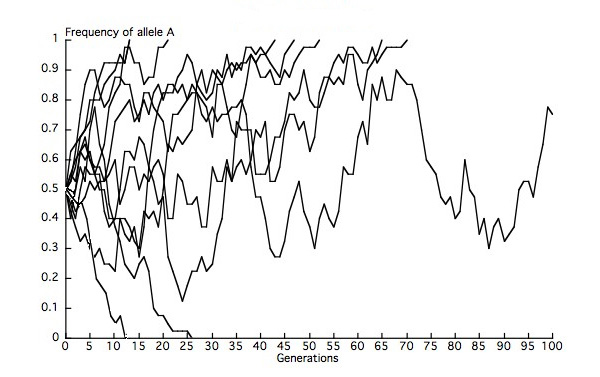
Sometimes, allele frequencies can change just by chance. This is called genetic drift. It’s more noticeable in small populations. Imagine a small group of 10 individuals. If one happens to have a rare allele, and it gets stepped on by chance, that allele might disappear from the group entirely, even if it wasn’t “unfit.”
While genetic drift changes allele frequencies, it doesn’t do so based on fitness. It’s random. Natural selection, driven by fitness differences, is non-random; it favors alleles that help survival and reproduction.
Tracking Evolutionary Change
Evolutionary change is simply a change in the inherited traits of a population over many generations. When allele frequencies change over time, this is evolutionary change at the most basic genetic level.
Natural selection, driven by fitness differences, is one of the main forces causing this change. As advantageous alleles become more common and disadvantageous ones become less common, the traits of the population shift.
Over vast stretches of time, small changes in allele frequencies, building up across many genes, can lead to big changes. This can result in the formation of new species, each adapted to its specific way of life and environment.
Population genetics provides the math and tools to track these changes. By sampling individuals and looking at their genes, scientists can measure allele frequencies in a population today and compare them to samples from the past (if available) or predict how they might change in the future based on known selection pressures.
Measuring Fitness Differences
How do scientists actually figure out the fitness of different types of individuals? They can’t always count all the offspring that reproduce successfully.
Instead, they often look at things that show differences in survival and reproduction:
* Survival rates: Do individuals with one allele combination live longer or survive a specific event (like a cold winter or a disease outbreak) better than others?
* Number of offspring produced: Do individuals with certain traits have more babies or seeds?
* Mating success: Do individuals with some traits attract more mates? (More mates often means more offspring).
By observing or experimenting, scientists can see if individuals with different traits (and likely different alleles) have different rates for these things. This helps them estimate the biological fitness of different genotypes (combinations of alleles) or phenotypes (observable traits).
For example:
* In a study of finches on the Galapagos Islands, researchers measured beak sizes. During a drought, birds with larger beaks could crack tougher seeds that smaller-beaked birds could not. The large-beaked birds survived and reproduced while many small-beaked birds died. This showed higher fitness for large-beaked birds during the drought, leading to an increase in the frequency of alleles for large beaks in the next generation.
This direct link between a trait (beak size), survival/reproduction (fitness), and the resulting change in the population’s characteristics (allele frequency and average beak size) is a classic example of how fitness drives evolutionary change through natural selection.
A Table Summary
Here’s a simple table to sum up the main points:
| Concept | Simple Idea | Link to Allele Frequency Change |
|---|---|---|
| Allele Frequency | How common a gene version is in a group. | The thing that changes during evolution by natural selection. |
| Biological Fitness | How good an individual is at passing on its genes (surviving + reproducing). | High fitness means contributing more alleles to the next generation. |
| Natural Selection | Nature favors individuals with traits that boost fitness. | Causes individuals with high-fitness alleles to reproduce more. |
| Differential Survival | Some live, some die. Those with helpful traits live more often. | Alleles in survivors are passed on; alleles in those who die are not. |
| Reproductive Success | Some have many young, some have few. Those with helpful traits have more successful young. | Individuals with high-fitness alleles produce more copies of those alleles. |
| Gene Pool | All the genes/alleles in a population. | Its makeup (allele frequencies) changes because of fitness differences. |
| Selection Pressure | Environmental factors that affect fitness differently. | Creates the advantage/disadvantage for certain traits/alleles. |
| Adaptation | A helpful trait that increases fitness in an environment. | Becomes more common in the population as its alleles increase in frequency. |
| Evolutionary Change | Changes in the inherited traits of a population over time. | Is the result of changes in allele frequencies driven by forces like natural selection. |
The Ongoing Process
Fitness is not a fixed thing. It can change if the environment changes. If the brown soil in our mouse example turned white, the white mice would suddenly have higher fitness than the brown mice. The selection pressure would reverse. The allele frequencies would start to shift in the opposite direction.
This shows that evolution is a continuous process, shaped by the environment and the fitness differences it creates among individuals. The constant interplay between variation, inheritance, and the environment, filtered through differences in fitness and reproductive success, drives the amazing diversity of life we see on Earth. Every living thing alive today carries alleles that were successful for their ancestors, giving them the fitness needed to survive and reproduce in the past.
FAQ
Q: Does higher fitness mean an individual is stronger or healthier?
A: Not always in the way we usually think. Biological fitness is purely about passing on genes. A seemingly weak or sick individual might have very high fitness if it manages to produce many healthy, reproducing offspring. While health often helps survival and reproduction, fitness is the result of all factors affecting gene transmission, not just physical strength.
Q: Can fitness change over time?
A: Yes, absolutely. Fitness is linked to the environment. If the environment changes (e.g., climate shifts, a new predator arrives, a new food source appears), the traits that provide high fitness can also change. An allele that was once beneficial might become harmful, and vice versa.
Q: Does natural selection create new alleles?
A: No. Natural selection acts on the variation that already exists in a population or is created by mutation. Mutation is the source of new alleles. Natural selection then sorts through these existing and new alleles, favoring those that increase fitness.
Q: Is evolution by natural selection a random process?
A: Variation (like mutation) is largely random. However, natural selection itself is not random. It is a directed process where fitness differences determine which alleles become more or less common. Individuals with traits that increase fitness are systematically favored over those with traits that decrease fitness.
Q: If an allele has low frequency, does that mean it has low fitness?
A: Not necessarily. An allele might be rare because:
* It is new (a recent mutation).
* It is only beneficial in rare circumstances.
* Its frequency is low due to random chance (genetic drift), especially in a small population.
* It might be a recessive allele that is hidden when the dominant, higher-fitness allele is present.
Low frequency can be a result of low fitness, but it’s not always the reason.