How is gymnastics scored? Gymnastics scoring looks at two main things: how hard the routine is and how well the gymnast does it. Judges give points for both. This makes up the final score. This guide will break down how judges watch routines and decide the points. We will look at the rules set by the big governing body, the FIG.
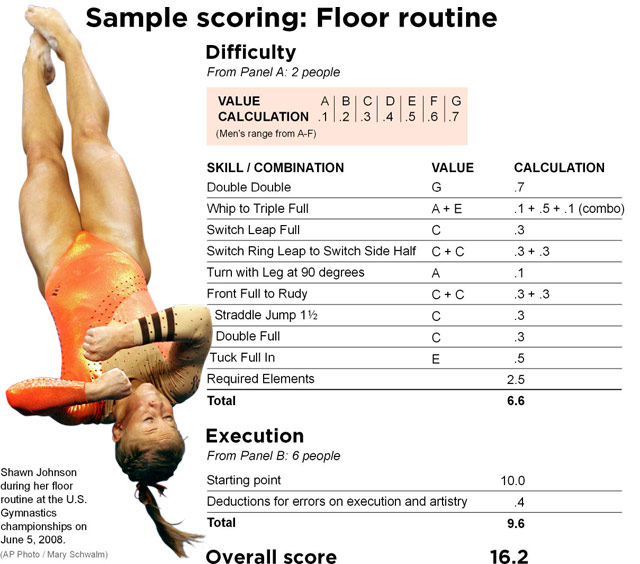
Image Source: i.sstatic.net
Grasping the Scoring Basics
Gymnastics scoring might seem hard at first glance. But it follows clear rules. The FIG scoring rules guide every competition. FIG stands for Fédération Internationale de Gymnastique. This is the world group for gymnastics.
Judges watch every move. They look at a gymnast’s routine very closely. They check how hard the moves are. They also check how perfectly the gymnast does them. Every routine starts with a possible score. Points are added and taken away based on the rules.
The scoring system has changed over time. It used to be out of a perfect 10.0. Now, the scoring is different. It has two main parts that add together.
Deciphering the Two Main Scores
Today, a gymnast’s total score comes from two parts. Think of it like two separate reports.
1. The Difficulty Score (D-score): This score looks at how hard the routine is. It counts the value of the moves the gymnast does.
2. The Execution Score (E-score): This score looks at how well the gymnast performs the routine. It checks for mistakes or flaws.
These two scores add up. They give the gymnast their score for that piece of equipment.
Fathoming the Difficulty Score (D-score)
The difficulty score, or D-score, shows how tough a routine is. This score has no limit. The harder the routine, the higher this score can be.
The D-score comes from a few things:
* Value of Skills: Every move in gymnastics has a value. Easy moves have low values. Hard moves have high values. These values are set by the FIG.
* Connection Value: Sometimes, linking two or more moves together without stopping adds extra points. This rewards gymnasts for flowing between hard skills.
* Composition Requirements: For most events, gymnasts must show certain types of moves. These are called composition requirements. Meeting these adds points to the D-score.
Let’s look closer at each part.
Interpreting Skill Values
Every skill is rated with a letter. A skills are the easiest. G skills are very hard. Some super hard skills go beyond G. They are rated with numbers, like an H skill (worth 0.8 points) or an I skill (worth 0.9 points).
Here is a simple look at the skill values:
| Skill Rating | Point Value |
|---|---|
| A | 0.1 |
| B | 0.2 |
| C | 0.3 |
| D | 0.4 |
| E | 0.5 |
| F | 0.6 |
| G | 0.7 |
| H | 0.8 |
| I | 0.9 |
| etc. | Higher |
To get the base D-score, judges look at the hardest moves. For women, they count the top 8 skills. For men, it depends on the event. They add up the values of these hardest skills.
Gauging Connection Value
Gymnasts get extra points for connecting moves. This means doing one skill right after another without a pause. This makes the routine harder and smoother.
For example, doing a difficult flip right into another difficult flip might get connection value. The specific connections that get extra points are listed in the FIG rules. These connection values are usually small, like 0.1 or 0.2 extra points. But they add up in a difficult routine.
Appraising Composition Requirements
Each piece of equipment has rules about what kinds of moves a routine must include. These are composition requirements. Think of them as boxes the gymnast must tick.
For example, on Balance Beam, a gymnast must do a turn, a leap or jump with a certain split, and a series of acrobatic moves. On Floor Exercise, they need tumbling passes, turns, and leaps. Meeting these requirements adds points to the D-score, often 0.5 or more total. If a requirement is missed, the gymnast does not get those points.
How the D-Score Panel Works
A special group of judges decides the D-score. They are called the D panel. They watch the routine and identify all the skills. They check the connections and see if the composition requirements are met.
They use video replay to make sure they see every skill correctly. The D-score they give is based purely on the list of moves and how they are linked. It does not look at how well the moves were done.
The start value under the old system was 10.0. In the current system, the D-score works differently. It is open-ended. This means there is no maximum limit to the D-score. A routine with very hard skills and good connections can get a high D-score. A routine with easier skills will have a lower D-score.
Interpreting the Execution Score (E-score)
The execution score, or E-score, measures how well the gymnast performs the routine. It starts high and points are taken away for mistakes.
The E-score always starts at 10.0 points for women and men in major competitions. This is like having a perfect starting point. Judges then look for flaws and take away points. These taken points are called deductions.
Fathoming Deductions
Deductions are points taken away from the E-score. Judges look for mistakes in form, body shape, landing, and artistry. Every mistake, no matter how small, leads to a deduction.
Judges work together to agree on deductions. There are several judges on the E panel. They each watch the routine and note mistakes. Their scores are then averaged, often dropping the highest and lowest scores to get a final E-score from the panel.
Deductions come in different sizes:
* Small Errors: These might be things like a slightly bent leg, a foot not fully pointed, or a small wobble. These usually cost 0.1 points.
* Medium Errors: These are bigger mistakes. Examples include a clearly bent arm or leg, a hand touching the mat, or a big wobble on the beam. These often cost 0.3 points.
* Large Errors: These are major mistakes. Falling off the beam or bars, taking many steps on a landing, or stopping in the middle of a routine are large errors. These usually cost 0.5 points or more.
* Falls: A fall off the equipment (like beam or bars) or sitting down on a landing costs 1.0 point.
Here is a table showing common deduction values:
| Type of Error | Typical Deduction |
|---|---|
| Small error (form) | 0.1 |
| Medium error (form) | 0.3 |
| Large error (form) | 0.5 |
| Wobble (Balance Beam) | 0.1, 0.3, or 0.5 |
| Step on landing | 0.1 or 0.3 |
| Large step/stumble on landing | 0.5 |
| Hands down on landing | 0.5 |
| Fall | 1.0 |
The E-score judges apply these deductions based on the gymnastics judging criteria. These criteria are detailed in the FIG Code of Points. They describe exactly what a perfect skill looks like and what different levels of errors cost.
Assessing Artistry (Floor Exercise & Balance Beam)
On Floor Exercise and Balance Beam, the E-score also includes points for artistry. This is about how the gymnast presents their routine.
* Choreography: How well the moves fit together and match the music (Floor).
* Expression: How the gymnast shows feeling and style.
* Presentation: Confidence and stage presence.
Lack of artistry or poor connection to the music can lead to deductions from the E-score.
Understanding Neutral Deductions
There is another type of deduction called a neutral deduction. These deductions are not related to the gymnast’s performance or the routine’s difficulty. They are taken for rule breaks that are not part of the routine itself.
Examples of neutral deductions include:
* Going out of bounds on the Floor Exercise area (0.1 or 0.3 points).
* The coach standing on the mat during the routine (except in certain cases like warm-up or helping on bars).
* Not wearing the correct uniform.
* Taking too long to start a routine.
* Music issues on Floor Exercise.
These deductions are subtracted from the final score, after the D-score and E-score are added together. They are applied by the Head Judge or Superior Jury.
Calculating the Final Gymnastics Score
The final gymnastics score for a routine is simple to calculate once you have the D-score, the E-score, and any neutral deductions.
The formula is:
Final Score = D-score + E-score – Neutral Deductions
Let’s look at an example:
* A gymnast performs a routine.
* The D panel judges the routine’s difficulty and gives a D-score of 5.8.
* The E panel judges the execution and takes away a total of 1.5 points in deductions from the starting 10.0 E-score. So, the E-score is 10.0 – 1.5 = 8.5.
* The gymnast stepped out of bounds on Floor, resulting in a neutral deduction of 0.1 points.
The final gymnastics score would be:
5.8 (D-score) + 8.5 (E-score) – 0.1 (Neutral Deduction) = 14.200
This 14.200 is the score that shows up in the competition results.
The Judging Process: How It Happens
Several judges watch each routine. There is a D panel and an E panel. A Head Judge oversees everything. Sometimes there is also a Superior Jury who can review scores.
- D Panel: These judges focus on the difficulty of the moves, connections, and requirements. They build the D-score.
- E Panel: These judges watch for mistakes in execution and form. They start with 10.0 and take off deductions to get the E-score.
- Head Judge: They make sure the rules are followed. They oversee both panels and apply neutral deductions.
- Superior Jury: At big events, this group can review scores if there is a question or problem.
Scores are usually shown quickly after a routine finishes. This lets everyone see how the gymnast did right away.
Gymnastics Judging Criteria Explained
The gymnastics judging criteria are the detailed rules judges follow. These are found in the FIG Code of Points. This book is updated every few years. It lists:
* All recognized skills and their values (A, B, C, etc.).
* How skills must look when performed perfectly.
* Specific deductions for different errors (bent knees, flexed feet, wrong body shape, etc.).
* Rules for connections and composition requirements.
* Rules for neutral deductions.
Judges train hard to learn these criteria. They must be able to see mistakes quickly and accurately. The criteria aim to make scoring fair and consistent for everyone.
However, there can still be small differences between judges. This is why multiple judges are used, and scores are often averaged.
Scoring Differences by Apparatus
Scoring works the same way (D-score + E-score – deductions) for all events. But what the judges look for is different for each piece of equipment.
Women’s Artistic Gymnastics (WAG)
- Vault: Gymnasts perform one or two vaults. The D-score comes from the value of the specific vault done. The E-score judges the run, the push off the springboard and table, the body shape in the air, and the landing. Deductions are taken for bent legs, twisted body, messy landing, etc.
- Uneven Bars: Routines are full of swings, handstands, releases and catches, and pirouettes. The D-score counts the hardest moves and connections. The E-score judges swings, handstands, body shape, rhythm, and the landing of the dismount. Deductions occur for pauses, poor handstands, bent arms, flexed feet, or messy dismounts.
- Balance Beam: Routines include turns, leaps, jumps, acrobatic series, and a dismount, all on a beam only 4 inches wide. The D-score comes from the hardest moves, connections, and requirements. The E-score judges balance (wobbles cost points!), body shape, confidence, and the dismount landing. This event is known for high deductions due to wobbles and falls.
- Floor Exercise: Gymnasts combine tumbling passes, leaps, jumps, turns, and dance moves to music. The D-score is for the hardest tumbling, leaps, turns, and connections. The E-score judges the execution of all moves, body shape, landing of tumbling passes, artistry, and how well the routine fits the music. Going outside the marked floor area results in a neutral deduction.
Men’s Artistic Gymnastics (MAG)
- Floor Exercise: Focus is more on tumbling and strength moves than dance. D-score from tumbling, strength, and flexibility moves. E-score judges execution, landings, and form.
- Pommel Horse: Routines are complex circles, travels, and handstands using only hands on the horse. D-score from circles, travels, and handstands. E-score judges body shape, leg form (keeping legs together and straight), and rhythm. Falls are common and costly.
- Still Rings: Routines show strength holds, swings, and dismounts. D-score from strength holds and swings. E-score judges body tension (no shaking!), held positions (must be still), and dismount landing. Rings should be still, not swinging too much.
- Vault: Similar to women’s vault, but vaults are often different and generally more focused on power. D-score based on the vault’s difficulty. E-score judges form in the air and landing.
- Parallel Bars: Routines have swings below and above the bars, presses, and handstands. D-score from swings, handstands, and transitions. E-score judges body shape, handstands, and landing.
- Horizontal Bar: Routines include giant swings, release moves high above the bar, and a dismount. D-score from release moves and swings. E-score judges swing amplitude (how high they swing), body form, and dismount landing.
In all events, a clean, precise performance with minimal errors will get a high E-score. A routine with very difficult moves will get a high D-score. The highest final gymnastics score goes to the gymnast who combines a high D-score with a high E-score.
The Role of Start Value (Historical Context)
You might still hear people talk about the 10.0 system or a start value. Under the old rules, every routine started from a base value, often 10.0. Gymnasts added bonus points for difficulty and connections. Deductions were taken from the base value.
The current system is different. The D-score is the value built from difficulty, connections, and requirements. It is not added to a 10.0. The E-score starts at 10.0, and points are only taken off.
So, while the E-score starts at 10.0, this is not the routine’s start value in the old sense. The routine’s potential highest score is the D-score + 10.0 (if there were zero execution errors). But since no routine is perfect, the real potential is D-score + (10.0 – minimal deductions).
The open-ended D-score lets gymnasts push the limits of difficulty. This has led to amazing new skills being performed.
Summary: Key Points of Scoring
- Gymnastics scoring is based on FIG scoring rules.
- Scores have two main parts: Difficulty Score (D-score) and Execution Score (E-score).
- The D-score measures how hard a routine is (skills, connections, requirements). It has no upper limit.
- The E-score measures how well a routine is performed. It starts at 10.0.
- Deductions are taken from the E-score for mistakes (form, wobbles, steps, falls).
- Gymnastics judging criteria tell judges what to look for and how much deductions should be.
- Neutral deductions are taken for rule breaks not related to the routine itself.
- The final gymnastics score is D-score + E-score – Neutral Deductions.
- A high score needs both hard moves done well.
Learning how gymnastics is scored helps you appreciate the sport even more. You can watch routines and start to see the difficult skills and the small details the judges are looking at.
Frequently Asked Questions
Is scoring the same for men and women?
The basic system (D + E – penalties) is the same. But the specific rules for skills, requirements, and apparatus are different between women’s artistic gymnastics (WAG) and men’s artistic gymnastics (MAG).
What happens if gymnasts have the same score?
In many competitions, ties are allowed. If gymnasts finish with the exact same final gymnastics score, they share the same rank. In some specific tie-breaking situations (like qualifying rounds or specific finals), the gymnast with the higher E-score might be placed higher. If E-scores are also tied, the higher D-score might be used. Rules vary by competition.
Can a gymnast’s score be changed after it is shown?
Yes, sometimes. If a coach or team believes there was a clear error in judging (like misidentifying a skill for the D-score), they can ask the judges or Superior Jury to review the score. This process is called an inquiry. If the review finds a mistake, the score can be changed.
Do different judges give different scores?
Yes, it is normal for E-score judges to have slight differences in the deductions they see. This is why their scores are often averaged. The D-score judges usually agree more closely as they are judging objective difficulty elements. However, judges must be highly trained and follow the same FIG scoring rules to keep scoring as fair as possible.
How perfect does a routine have to be for a perfect E-score (10.0)?
A routine must be truly perfect to get a 10.0 E-score. This means zero mistakes in execution, form, or artistry. Every line must be straight, every toe pointed, every landing stuck without any movement. This is very rare, especially with the difficulty of modern routines. A 10.0 E-score is the goal, but getting very close (like 9.8 or 9.9) is considered excellent execution.
By understanding the D-score, E-score, and deductions, you can follow gymnastics competitions with a clearer picture of why scores are given. It shows the amazing mix of strength, flexibility, daring, and precision that top gymnasts achieve.