Do you wonder how to get stronger forearms? Maybe you ask yourself, “Can I train my forearms to be bigger?” The answer is yes, you absolutely can. Working your forearms can give you a stronger grip, help you lift more weight in other exercises, and make your arms look more balanced and powerful. It is easy to start exercising your forearms now. This guide will show you how to do it right.
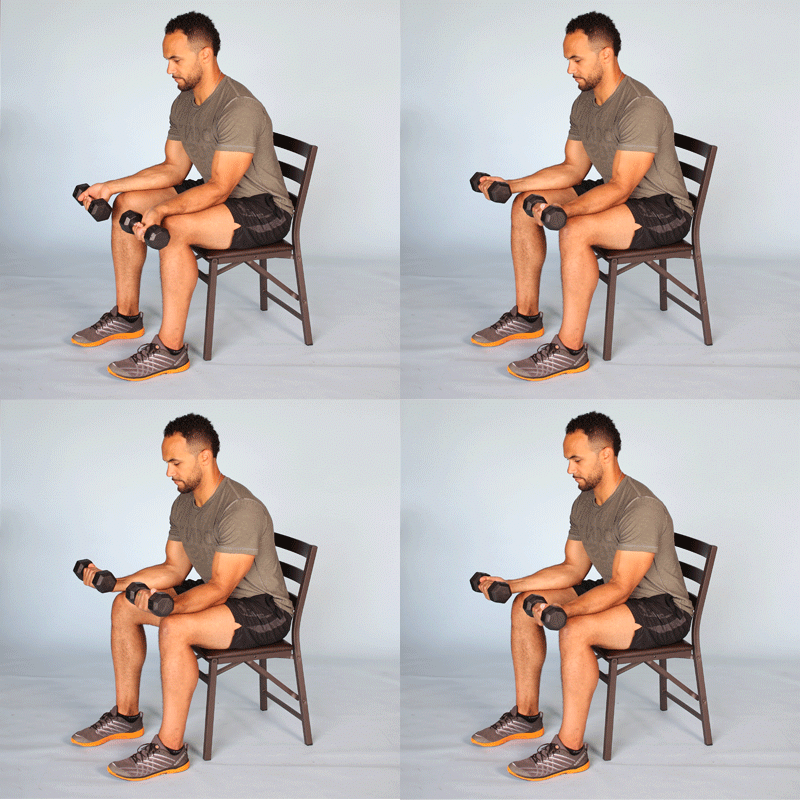
Image Source: media.post.rvohealth.io
Grasping Forearm Anatomy
It helps to know what your forearms are made of. This part does not need to be hard. Your forearm muscles help you move your hand and wrist.
There are two main groups of muscles in your forearm:
- Forearm Flexors: These muscles are on the inside of your forearm. They help you bend your wrist forward, like when you hold a heavy bag. They make up the thicker part of your forearm.
- Forearm Extensors: These muscles are on the outside of your forearm. They help you bend your wrist backward, like when you point your hand up. They are often smaller than the flexors.
There is also a muscle higher up, near your elbow, called the brachioradialis. This muscle helps you bend your elbow, especially when your hand is turned in a certain way, like when doing a hammer curl. Working all these muscles gives you strong, complete forearms.
Why Strong Forearms Matter
Working your forearms does more than just make them look good. Strong forearms help you in many ways.
- Better Grip Strength: This is very important. A strong grip helps you hold onto weights for longer. This means you can lift heavier weights in exercises like deadlifts, pull-ups, and rows. If your grip gives out before your back or legs, your training suffers. Strong forearms fix this.
- Lifting More Weight: As mentioned, a stronger grip lets you handle more weight in many lifts. This leads to more overall strength and muscle growth throughout your body.
- Helping Daily Tasks: Think about carrying groceries, opening tight jars, or using tools. Strong forearms make these everyday things much easier.
- Injury Prevention: Strong wrist and forearm muscles can help protect your elbows and wrists from injury. They provide stability.
- Better Sports Performance: Many sports need strong forearms and grip. Think about climbing, baseball, tennis, martial arts, and more.
- Balanced Look: If you train your biceps and triceps but forget your forearms, your arms might look unbalanced. Working forearms adds to the overall look of strength and fitness.
Core Principles for Building Forearms
Like any muscle group, forearms grow and get stronger when trained the right way. Keep these simple ideas in mind:
- Be Consistent: You need to work your forearms regularly. A couple of times a week is often good.
- Use Full Range of Motion: When doing exercises, move your wrist or hand through its complete range. Don’t do small, quick movements. This works the muscles fully.
- Focus on Form: Doing the exercise correctly is more important than lifting heavy weight. Bad form can lead to injury and poor results. Use a weight you can control.
- Feel the Muscle: Try to feel the forearm muscles working with each rep. This mind-muscle connection helps make the exercise more effective.
- Don’t Forget Both Sides: Work both the flexor and extensor muscles. Many people only do exercises for the flexors, which can cause muscle imbalance.
- Rest is Key: Just like other muscles, forearms need time to recover and grow after you work them.
Essential Forearm Exercises
Now, let’s look at the best exercises to build strong forearms. You don’t need lots of fancy machines. Many effective forearm workouts use just dumbbells or your own body weight.
Wrist Curls
This is one of the most direct ways to work your forearm flexor exercises.
- What it works: Mainly the forearm flexors (the muscles on the palm side).
- How to do it:
- Sit on a bench or chair.
- Hold a pair of forearm exercises dumbbells with your palms facing up.
- Rest your forearms on your thighs. Let your hands hang off your knees, palms up.
- Lower the dumbbells slowly as far as you can, letting your fingers stretch a bit.
- Now, curl the dumbbells up by bending your wrist. Bring your hand up as high as you can. Keep your forearm pressed against your thighs. Only your hand moves.
- Squeeze your forearm muscles at the top.
- Lower the weight slowly back down.
- Tips:
- Use a weight that lets you do at least 10-15 good reps with control.
- Keep the movement slow and controlled.
- You can do this with one hand at a time if that feels better.
- You can also use a barbell instead of dumbbells, but dumbbells allow a bit more natural wrist movement.
Reverse Wrist Curls
This exercise targets the muscles on the back of your forearm. It’s important for balance and strength. This is a key exercise for forearm extensor exercises.
- What it works: Mainly the forearm extensors (the muscles on the back of the forearm).
- How to do it:
- Sit on a bench or chair.
- Hold a pair of forearm exercises dumbbells with your palms facing down (overhand grip).
- Rest your forearms on your thighs. Let your hands hang off your knees, palms down.
- Lower the dumbbells slowly as far as you can, letting your hand drop down.
- Now, lift the dumbbells up by bending your wrist backward. Bring your hand up as high as you can. Keep your forearm pressed against your thighs. Only your hand moves.
- Squeeze the muscles on the back of your forearm at the top.
- Lower the weight slowly back down.
- Tips:
- You will likely use less weight for this exercise than regular wrist curls.
- Keep the movement slow and controlled.
- You can do this with one hand at a time.
- A barbell can also be used, but again, dumbbells offer more freedom.
Hammer Curls
While mainly seen as a biceps exercise, hammer curls are excellent for the brachioradialis exercises and also build grip strength exercises.
- What it works: Brachioradialis, brachialis (under the biceps), and biceps. Also strongly works grip.
- How to do it:
- Stand or sit. Hold a forearm exercises dumbbells in each hand.
- Let your arms hang straight down. Your palms should face your body (like you are holding a hammer).
- Keep your upper arms still. Bend your elbows to curl the dumbbells up towards your shoulders. Keep your palms facing each other the whole time.
- Curl the weight up as high as you can comfortably go without moving your upper arm or shoulder.
- Squeeze at the top.
- Lower the dumbbells slowly back to the start position.
- Tips:
- Don’t swing the weights. Use control.
- Keep your wrists straight throughout the movement. Don’t let them bend or drop back. This keeps tension on the brachioradialis and improves grip work.
- This exercise feels natural for many people.
Reverse Curls (Barbell or Dumbbell)
This exercise is similar to hammer curls in that it hits the brachioradialis hard, but it uses an overhand grip. It is another good brachioradialis exercises.
- What it works: Brachioradialis, brachialis, and forearm extensors. Less focus on the biceps compared to standard or hammer curls.
- How to do it (with a barbell):
- Stand holding a barbell with an overhand grip (palms facing down). Your hands should be about shoulder-width apart.
- Let the barbell hang straight down. Your arms are straight.
- Keep your upper arms still. Bend your elbows to curl the barbell up towards your shoulders. Keep your palms facing down the whole time.
- Curl the weight up as high as you can comfortably go without moving your upper arm or shoulder.
- Squeeze the top part of your forearm/lower bicep area at the top.
- Lower the barbell slowly back to the start position.
- How to do it (with dumbbells):
- Stand or sit holding a forearm exercises dumbbells in each hand with an overhand grip (palms facing down).
- Curl the dumbbells up towards your shoulders, keeping palms down.
- Lower slowly.
- Tips:
- Use lighter weight than you would for regular curls. This grip is weaker for lifting heavy.
- Focus on feeling the muscles work in the outer part of your upper forearm and elbow area.
- Keep your wrists straight.
Farmer’s Walk Exercise
This is a classic strength exercise that builds amazing grip strength exercises and works many other muscles too. It is a full-body exercise that taxes the forearms heavily.
- What it works: Grip strength, forearm muscles (flexors and extensors working hard to hold), traps, shoulders, core, legs (walking).
- How to do it:
- Pick up a heavy dumbbell, kettlebell, or special farmer’s walk bar in each hand. The weight should be challenging to hold for a distance.
- Stand tall with your shoulders back and down, core tight.
- Walk slowly and steadily for a set distance or time.
- Keep your posture upright. Don’t let the weights pull you forward or make you slouch.
- Tips:
- Use the heaviest weight you can hold with good form for the chosen distance or time.
- Breathe normally.
- Focus on keeping your grip tight the entire time.
- Start with shorter distances or times and increase as your grip gets stronger. Aim for 30-60 seconds or 50-100 feet.
Other Grip Builders
Besides the farmer’s walk, there are other direct ways to work your grip strength exercises.
- Dead Hangs:
- Hang from a pull-up bar with your hands slightly wider than shoulder-width. Use an overhand grip (palms away from you).
- Just hang there. Let your body relax except for your grip holding on.
- Hold for as long as you can.
- Repeat this for multiple sets. This is simple but brutally effective for grip endurance.
- Plate Pinch:
- Take two weight plates (the flat round weights used on barbells). Use plates with a smooth side facing out if possible, making it harder to grip.
- Put the smooth sides facing away from each other. Pinch the two plates together with your fingers and thumb of one hand.
- Hold them for as long as you can.
- This works the pinching strength of your fingers and thumb, a different type of grip.
- Start with lighter plates that are harder to pinch (like 10 or 15 pound plates), then move to heavier ones as you get stronger.
- Thick Bar Training:
- If your gym has special thick barbells or dumbbells, use them for exercises like curls, rows, or deadlifts. The thicker bar makes your grip work much harder just to hold on.
- You can also buy thick grips that wrap around regular bars to make them thicker.
Zottman Curls
This exercise is a great way to hit the biceps, brachialis, brachioradialis, and both forearm flexors and extensors in one movement. It uses forearm exercises dumbbells.
- What it works: Biceps, brachialis, brachioradialis, forearm flexors, forearm extensors.
- How to do it:
- Stand or sit. Hold a forearm exercises dumbbells in each hand with your palms facing forward (like a regular curl).
- Curl the dumbbells up towards your shoulders, like a regular biceps curl.
- At the top, when the dumbbells are near your shoulders, rotate your hands so your palms face down. This works the forearm extensors.
- Slowly lower the dumbbells while keeping your palms facing down (like a reverse curl).
- At the bottom, rotate your hands back so your palms face forward again. This works the forearm flexors a little as you get ready for the next rep.
- Repeat the curl.
- Tips:
- Use a weight that allows you to control the rotation and the slow lowering part.
- Focus on the slow, controlled lowering with palms down. That’s where the forearm extensors get a lot of work.
- Make sure the rotation happens smoothly at the top and bottom.
Crafting Your Forearm Workouts
You don’t need a long, complex routine. You can add forearm exercises to your existing training or do a short forearm session on its own. Many people like to add them at the end of an arm workout or a back workout (since back exercises already work grip).
How Often to Train Forearms
Since forearms are used in many exercises, they might recover faster than bigger muscles. Training them 2-3 times a week is usually good. Make sure you have at least a day of rest between forearm sessions.
Sets and Reps
- For muscle size (hypertrophy), 3-4 sets of 10-15 repetitions for exercises like wrist curls, reverse wrist curls, and Zottman curls works well.
- For strength, especially grip strength exercises like the farmer’s walk exercise or dead hangs, focus on time or distance rather than reps. Hold for 30-60 seconds or walk for 50-100 feet. For plate pinches, hold for time too. For hammer curls and reverse curls, 3-4 sets of 8-12 reps are good for strength and size.
- You can train forearms with lighter weights for higher reps (20-25) sometimes to build endurance.
Sample Forearm Workouts
Here are a few ideas for forearm workouts you can do. Pick one and try it. Remember to warm up first!
Sample Workout 1: Quick Add-On
Do this at the end of your regular workout.
| Exercise | Sets | Reps/Hold Time | Focus | Equipment |
|---|---|---|---|---|
| Wrist Curls | 3 | 15-20 reps | Forearm Flexors | Dumbbells (light-medium) |
| Reverse Wrist Curls | 3 | 15-20 reps | Forearm Extensors | Dumbbells (lighter) |
| Dead Hang | 3 | Max hold time | Grip Strength Endurance | Pull-up bar |
Sample Workout 2: Dedicated Forearm & Grip Day
You could do this on a day separate from heavy lifting, or perhaps before a lighter training day.
| Exercise | Sets | Reps/Hold Time | Focus | Equipment |
|---|---|---|---|---|
| Reverse Curls | 3 | 10-12 reps | Brachioradialis, Extensors | Barbell or Dumbbells |
| Hammer Curls | 3 | 10-12 reps | Brachioradialis, Grip, Biceps (partial) | Dumbbells |
| Wrist Curls | 4 | 12-15 reps | Forearm Flexors | Dumbbells or Barbell |
| Reverse Wrist Curls | 4 | 12-15 reps | Forearm Extensors | Dumbbells or Barbell |
| Farmer’s Walk Exercise | 3 | 50-100 feet | Grip Strength, Full Body | Heavy Dumbbells/Kettlebells |
| Plate Pinch | 3 | Max hold time | Pinch Grip Strength | Weight Plates |
Sample Workout 3: Size Focused
Higher volume to target muscle growth.
| Exercise | Sets | Reps | Focus | Equipment |
|---|---|---|---|---|
| Wrist Curls | 4 | 15-20 reps | Forearm Flexors | Dumbbells or Barbell |
| Zottman Curls | 3 | 10-15 reps | Full Arm, Forearm Focus | Dumbbells |
| Reverse Curls | 3 | 12-15 reps | Brachioradialis, Extensors | Barbell or Dumbbells |
| Reverse Wrist Curls | 4 | 15-20 reps | Forearm Extensors | Dumbbells or Barbell |
| Hammer Curls | 3 | 12-15 reps | Brachioradialis, Grip | Dumbbells |
Remember to adjust the weight so you can complete the sets and reps with good form. As you get stronger, you can slowly increase the weight, reps, or hold times.
Avoiding Common Forearm Training Mistakes
It’s easy to make small mistakes that can slow your progress or even cause pain. Watch out for these:
- Using Too Much Weight: This is the most common mistake. If the weight is too heavy, you will use momentum or other muscles to lift it. This takes the work away from your forearms. Use a lighter weight you can control fully.
- Not Using Full Range of Motion: Don’t do small, quick movements. Let your wrist bend fully in both directions (up and down) for curls. This makes the muscles work through their full length.
- Neglecting Extensors: Many people only do wrist curls (flexors). Ignoring reverse wrist curls (extensors) can cause muscle imbalances. This might even lead to pain or injury. Always train both sides.
- Not Resting: Your forearms need rest to grow. Training them hard every single day is too much. Give them at least 24-48 hours to recover after a hard workout.
- Bad Form: Swinging the weight, using your body, or not keeping your forearm stable takes the focus off the forearm muscles. Watch yourself or ask someone to check your form.
- Only Training Grip or Only Training Curls: A complete forearm workout should include exercises for flexors, extensors, brachioradialis, and direct grip strength.
Rest and Getting Stronger
Muscles don’t grow when you are lifting weights. They grow when you are resting and eating well after you lift weights. This is true for your forearms too.
When you exercise, you create tiny tears in the muscle fibers. During rest, your body repairs these tears. It makes the fibers a little bigger and stronger than before. This is how you build muscle and strength.
Getting enough sleep is a big part of recovery. Eating enough protein helps your body repair the muscle fibers.
Listen to your body. If your forearms are very sore, give them another day of rest. Pushing through pain can cause injury. Some soreness is normal, but sharp or lasting pain is a sign to stop and rest.
Putting It All Together
Building stronger, bigger forearms is very possible. It takes time, just like building any other muscle group. You don’t need complex machines. Simple tools like forearm exercises dumbbells are very effective.
Remember the key points:
- Train both your flexors and extensors.
- Include brachioradialis exercises like hammer curls and reverse curls.
- Add direct grip strength exercises such as the farmer’s walk exercise or dead hangs.
- Focus on good form and a full range of motion.
- Use a weight you can control.
- Be consistent with your training, 2-3 times a week.
- Allow time for rest and recovery.
By following these steps, you will see your grip get stronger and your forearms start to grow. Stick with it, and you will get results.
Frequently Asked Questions
Here are answers to common questions people ask about forearm training.
Can I train my forearms every day?
No, training your forearms every day is not a good idea. Like other muscles, they need time to rest and repair. If you work them hard, 2-3 times a week is enough. If you use them lightly in other exercises, maybe twice a week is best for direct forearm work.
Do I need special tools to exercise forearms?
No, you do not need special tools. You can do many great forearm workouts with just forearm exercises dumbbells, a barbell, and a pull-up bar. Things like resistance bands, grip trainers, or thick bar grips can be helpful additions, but they are not needed to start.
My forearms hurt when I do exercises. What should I do?
First, check your form. Are you using too much weight? Are you moving smoothly, or is it jerky? Try using lighter weight and focus only on the wrist movement. If the pain continues, rest for a few days. If it doesn’t get better, talk to a doctor or physical therapist. Don’t train through sharp pain.
How long does it take to see results from forearm training?
Seeing results takes time and depends on many things, like how often you train, how hard you train, your diet, and your body. You might feel your grip getting stronger in just a few weeks. Seeing a noticeable difference in size can take a few months of consistent training. Be patient and stick with your forearm workouts.
Are forearm workouts just for looks?
No, absolutely not. While bigger forearms might look good, the main benefit for many people is the increase in grip strength exercises. This improved grip helps in almost all other lifting exercises and makes many daily tasks easier. The strength benefits are often more important than the size benefits.
Should I use lifting straps when doing exercises like deadlifts?
If your main goal is to build grip strength exercises with exercises like deadlifts, try to avoid straps as long as possible. Lift the weight using only your hands until your grip is the weakest link. Once your grip starts to fail, you can use straps to continue working the larger muscles (like back or legs). But for dedicated grip and forearm training, rely on your own grip power.
Training your forearms is a smart move for anyone wanting overall strength, better lifting performance, and a stronger grip in life. Start today!