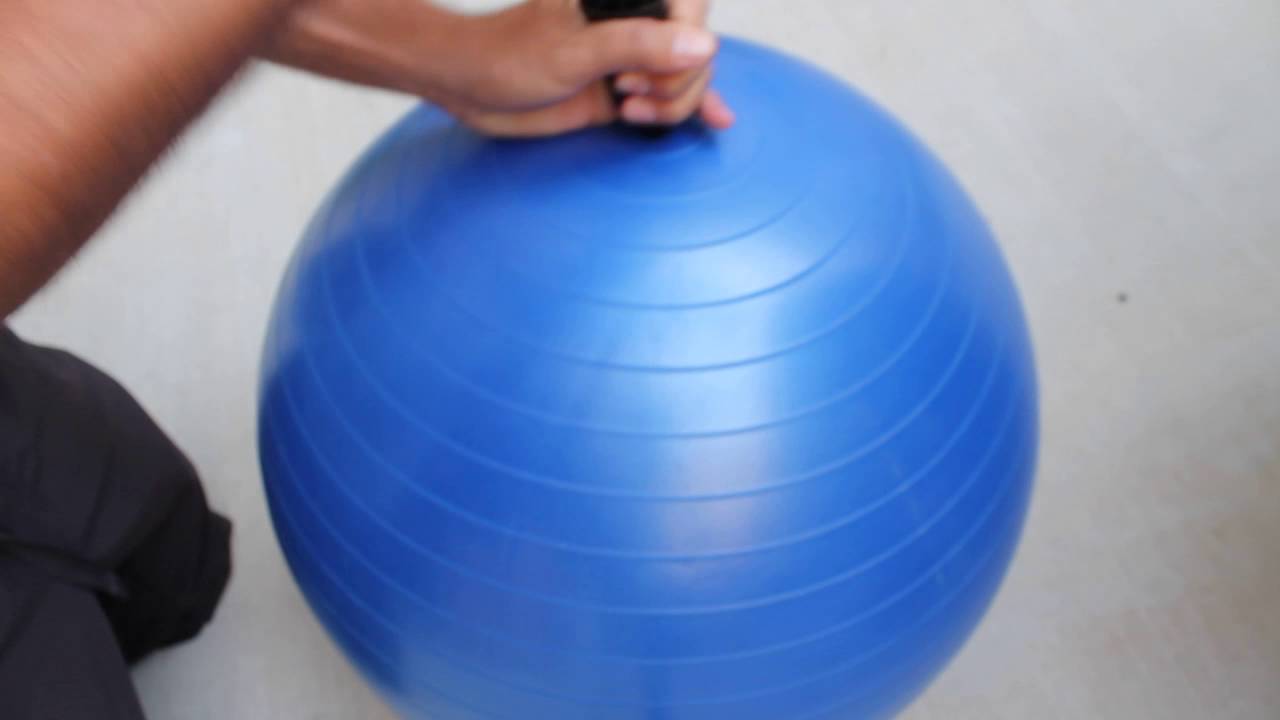
Image Source: i.ytimg.com
Easy Steps: How To Inflate Exercise Ball Correctly
Putting air in your exercise ball is simple. This guide shows you exactly how to inflate a stability ball the right way. Knowing how full should exercise ball be is key for safety and good workouts. Let’s get your ball ready!
Why Making Your Ball Right Matters
Having your exercise ball just right is very important. It needs enough air, but not too much. A ball with too little air feels soft and squishy. It is hard to balance on. It might not hold you up well during some exercises. This can make your workout less helpful. It can also make you feel shaky or unsafe.
A ball with too much air is too hard. It feels like a balloon ready to pop. This is also bad. A too-hard ball is not safe. It can burst if you put too much weight on it. This could cause you to fall and get hurt. A ball that is too hard also does not let you move as you need to. Many exercises need the ball to give a little. If it is too hard, it cannot do this.
So, getting the air level correct is not just about having a ball. It is about being safe. It is about making your exercises work well. It is about making your ball last a long time. Properly inflate exercise ball steps help with all these things. We will show you how to do it easily.
Get Ready to Pump Air
Before you start putting air in, get everything you need. It makes the job much easier. You will need a few simple things.
- Your exercise ball. Take it out of the box or bag. Lay it flat.
- The little plug or stopper. This is a small plastic piece. It seals the hole in the ball after you put air in. Make sure you do not lose this small piece. It is very important.
- Your exercise ball pump. Most balls come with a pump. This is called the included exercise ball pump. It might be a small hand pump exercise ball type. Or it might be a foot pump. Some people use their own pump. Maybe you have an electric pump for stability ball inflation. Any pump that fits the ball’s hole is okay. Just make sure you have one ready.
Find a clear spot to work. Make sure there are no sharp things on the floor. Sharp things could hurt your ball. A clean, flat spot is best. Unroll the ball gently. Let it sit for a bit. If it was packed tight, letting it sit helps it take shape. This makes it easier to put air in.
Make sure the ball is warm if it was in a cold place. Cold plastic is stiff. Warm plastic is softer and stretches better. This is extra helpful when you inflate fitness ball first time.
What Comes With Your Ball
Most new exercise balls come with helpful items. Look in the box or bag.
You should find:
* The deflated exercise ball itself. It looks like a flat, big balloon.
* One or maybe two small plastic plugs. These are the stoppers. They stop the air from coming out.
* A tool to take the plug out later. This is often a small plastic lever. It helps you pull the plug when you need to deflate exercise ball.
* A pump. This is often a compact hand pump exercise ball pump. It might look small, but it works. This is the included exercise ball pump we talked about.
Take everything out. Check that you have all these pieces. The plug is very small and easy to misplace. Keep it safe! Putting it in your pocket or a small dish nearby is a good idea.
Inflating Your Ball for the First Time
Inflate fitness ball first time is a bit different. New balls are made of strong stuff. This stuff needs to stretch out. When you first put air in, the ball might not get to its full size right away. This is normal. Do not try to pump it up all the way the first time.
Think of it like new shoes. You need to wear them a bit to break them in. An exercise ball is similar. Its material needs to get used to being big and round.
For the first inflation, pump air until the ball is about 80% full. It will look mostly round, but maybe a little soft. It will not feel super firm. That is okay. Put the plug in. Let the ball sit for 24 hours. This gives the material time to stretch slowly.
After a day, the ball will have stretched more. It will be bigger, even with the same amount of air. Now you can add more air. Pump it up to the correct size and firmness. We will talk more about how to check the right size soon. This slow first inflation helps the ball last longer. It stops too much stress on the seams. This is a good step for yoga ball inflation instructions too, as yoga balls are exercise balls.
Step-by-Step Guide to Putting Air In
Here are the steps to properly inflate exercise ball. These steps work whether it is the first time or you are adding air later.
Find the Air Hole
Look at your exercise ball. You will see a small hole. This is where the air goes in and comes out. It is also where the small plug goes. The hole is usually on one side of the ball. It looks like a small circle with an edge.
Get the Pump Ready
Take your exercise ball pump. It has a nozzle, which is the tip that goes into the ball. Make sure the nozzle is clear of dust. If you are using the included exercise ball pump, it’s usually ready to go. If you are using a different hand pump exercise ball pump or an electric pump for stability ball, make sure it has the right adapter. Most exercise balls use a standard small nozzle.
Put the Pump Nozzle In
Take the nozzle of the pump. Gently push it into the air hole on the ball. It should fit snugly. Push it in far enough so it stays put while you pump. But do not force it too hard. You do not want to hurt the ball’s hole.
Start Pumping Air
Now, start pumping!
- If you use a hand pump exercise ball pump: Pull the handle up, then push it down. Air goes in when you push down (usually). Keep doing this. It might take many pushes.
- If you use a foot pump: Step on the pump lever. It will go down and air goes in. Lift your foot, the lever comes up. Step down again. Keep going with your foot.
- If you use an electric pump for stability ball: Turn the pump on. Hold the nozzle steady in the ball’s hole. The pump does the work for you. Watch the ball. Do not walk away. Electric pumps work fast. You do not want to overfill the ball.
Keep pumping air into the ball. Watch the ball get bigger. As it gets bigger, it will become rounder.
Check the Size As You Pump
As you pump, stop sometimes. Look at the ball. Is it getting close to the size it should be? How full should exercise ball be? We will talk about this in more detail next. But for now, know your ball has a target size, like 55 cm, 65 cm, or 75 cm. Do not just guess. Check the size.
You can use a tape measure. Measure across the ball’s widest part. Or, if your ball came with a measuring tape or guide, use that. Some guides have a line drawn on the wall, and you pump until the ball reaches that line.
Pump air until the ball is the size you need. It should look round and feel firm when you push on it. But it should not feel like a rock. It should have some give.
Take the Pump Out Fast
Once the ball is the right size and firmness, take the pump nozzle out. Pull it out quickly and smoothly. As soon as you pull it out, air will start to come out of the hole.
Put the Plug In Fast
This is a quick step! As soon as the pump nozzle is out, grab the small plastic plug. Push the plug into the hole as fast as you can. Push it all the way in. It should make a seal. You should not hear air coming out anymore.
Push the plug firmly into the ball. Make sure it is sitting flat and flush with the ball’s surface. This keeps the air inside.
Let the Ball Rest
After you inflate fitness ball (especially the first time), let it rest. Leave it alone for a little while, maybe 30 minutes to an hour. This lets the material settle with the air inside. Then, check the size and firmness again. Sometimes it might feel a little less firm after resting, and you might need to add a tiny bit more air.
Checking How Full Your Ball Should Be
Knowing how full should exercise ball be is very important. It is about size and firmness.
Check the Size
Your ball has a size number. This is its diameter when fully inflated. It is usually in centimeters (cm). Common sizes are 55 cm, 65 cm, and 75 cm. The right size for you depends on your height.
Here is a simple guide based on height:
| Your Height | Recommended Ball Size |
|---|---|
| Under 5′ (152 cm) | 45 cm |
| 5′ to 5’6″ (152-167 cm) | 55 cm |
| 5’6″ to 6′ (167-183 cm) | 65 cm |
| Over 6′ (183 cm) | 75 cm |
Check the size as you pump. Use a tape measure from side to side. Make sure the ball is not wider or smaller than its stated size. Over-inflating it past its size is dangerous.
Check the Firmness
The ball needs to be firm, but not hard like a basketball. When you press on it with your hand, it should push back firmly, but your fingers should be able to press in a little bit.
A good way to check firmness and size together is the “sitting test.”
* Inflate the ball until it looks mostly full and feels firm.
* Sit on the ball with your feet flat on the floor.
* Look at your knees and hips. For most exercises, your knees should be level with your hips, or slightly lower. Your legs should make about a 90-degree angle at the knee.
* If your hips are much lower than your knees, the ball is too soft. It needs more air.
* If your hips are much higher than your knees, the ball is too hard or too big. You might need to let a little air out, or perhaps the ball size is wrong for your height.
This sitting test is key to properly inflate exercise ball for comfort and correct posture during workouts.
Using Different Pumps
You might use the included exercise ball pump, a hand pump exercise ball pump you bought, or an electric pump for stability ball. They all put air in, but they work differently.
Included Hand Pump
- These are small and often lightweight.
- They are great for travel or storing easily.
- They take more effort and time to inflate the ball fully because they move less air with each pump.
- Good for topping off air if the ball gets a little soft.
- Can be tiring for the first inflation.
Separate Hand Pump
- These can be bigger and more powerful than the included ones.
- They might have a floor stand or foot holders.
- They can pump air faster with less effort than small ones.
- Still takes manual work, but is often quicker and easier than the small included pump.
Electric Pump for Stability Ball
- These are the fastest and easiest option.
- You just plug it in and turn it on.
- They inflate the ball very quickly.
- You must watch the ball closely! It is easy to over-inflate with an electric pump. Stop the pump often to check the size and firmness.
- Make sure the nozzle fits the ball’s air hole. Some electric pumps come with different size nozzles.
No matter which pump you use for how to inflate stability ball, the process of putting the nozzle in, pumping, and quickly putting the plug in is the same. Using included exercise ball pump is fine, it just might take longer.
Do Not Over-Inflate Your Ball
Over-inflating is putting too much air in. This makes the ball too hard and too big. It is very important not to do this.
Risks of over-inflating:
* Bursting: The material is stretched too thin. Putting weight on it can cause it to pop. This is dangerous.
* Damaging the Ball: It can stretch the seams too much, making them weak. The ball might fail later.
* Bad for Exercise: A ball that is too hard does not work right for many moves. It does not provide the needed support or movement.
How to avoid over-inflating:
* Know the stated size of your ball (55 cm, 65 cm, etc.).
* Check the size often while pumping. Use a tape measure.
* Stop pumping when it reaches the correct diameter and feels firm but with some give.
* Do not pump it up until it feels rock hard.
* Be extra careful if using an electric pump for stability ball, as they work very fast.
If you think you have over-inflated it, you can let a little air out. We will show you how to deflate exercise ball next.
Keeping Your Ball Ready
Your exercise ball will slowly lose a little air over time. This is normal. Plastic materials can be a little bit porous. Also, changes in air temperature can affect the pressure inside. A ball left in a warm room might feel firmer than one in a cold room.
You should check the firmness of your ball regularly. Maybe once a week or before each workout. Push on it. Sit on it. Does it still feel right? Does it pass the sitting test (knees and hips level)?
If it feels soft, add a little more air using your exercise ball pump. It only takes a few pumps to make it firm again. Keeping it properly inflated ensures you get the most out of your workouts and the ball stays safe to use.
What If You Lost Your Pump?
It happens! You might have lost the included exercise ball pump. Do not worry. You can still inflate your ball.
- Buy a replacement exercise ball pump: Sporting goods stores, online shops, or stores that sell exercise equipment usually sell small hand pumps that work for exercise balls. Look for a “stability ball pump” or “yoga ball pump.”
- Use a bike pump (carefully): Some bike pumps, especially those for balls, might have a nozzle that fits. Be very careful. Bike pumps can push a lot of air quickly and to high pressures. It is easy to over-inflate a thin exercise ball with a powerful bike pump. Pump very slowly and check constantly.
- Use an electric air pump (for mattresses, etc.): Some electric pumps meant for air mattresses or other inflatables might have a nozzle adapter that fits. Again, these move air fast. Watch the ball very closely.
Make sure the nozzle fits snugly in the ball’s air hole. A loose fit means air will leak out as you try to pump it in. Having a dedicated exercise ball pump or a pump with the right adapter is the easiest way.
How to Deflate Your Exercise Ball
Sometimes you need to let the air out. Maybe you moved and need to pack it. Maybe you over-inflated it. Maybe you just need to store it away. Deflating is easy.
Steps to deflate exercise ball:
- Find the plug: Locate the small plastic plug in the ball’s air hole.
- Get the removal tool: If your ball came with a small plastic lever tool for removing the plug, use it. If not, you can use something like a blunt plastic knife or even your fingernail, but be careful not to damage the ball or the plug. Do NOT use anything sharp like a real knife or pin, this will damage the ball.
- Carefully remove the plug: Use the tool or your finger to gently pry under the edge of the plug. Work it around the plug until you can lift it out. Be ready, air will start coming out right away.
- Let the air out: You can just let the air escape on its own. This takes some time. You can help it along by gently pressing or rolling the ball. Start from the side away from the hole and roll towards the hole. This pushes the air out faster.
- Get all the air out: Keep pressing and rolling until the ball is flat. Try to get as much air out as possible for easier storage.
- Keep the plug safe: Put the plug somewhere you will not lose it. You will need it again to inflate fitness ball next time.
That’s how you deflate exercise ball. It is a simple process.
Yoga Ball Inflation Instructions
Is a yoga ball different from an exercise ball? No, not really. Yoga ball, stability ball, fitness ball, balance ball – these are often just different names for the same type of inflatable ball used for exercise, stretching, balance, and yoga.
So, yoga ball inflation instructions are the same as for any exercise ball. You will use the same steps: find the hole, put the pump in, pump air (using your exercise ball pump), check the size and firmness (sit on it!), and put the plug in quickly.
Just like with other uses, proper inflation is key for yoga. A ball that is too soft or too hard can make yoga poses difficult or unsafe. Follow the steps for how to inflate stability ball correctly to get your yoga ball ready for your practice. Make sure it passes the sitting test for comfort and stability during yoga poses.
Troubleshooting Little Problems
Sometimes things do not go perfectly. Here are some common small issues and how to fix them.
The Ball Won’t Seem to Get Big
- Check the pump connection: Is the pump nozzle pushed far enough into the ball’s hole? If it is loose, air is leaking out as you pump. Push it in more.
- Check the pump itself: Is the pump working? If it is a hand pump, check if air comes out of the nozzle when you pump. If it is electric, is it on and blowing air? The pump might be broken.
- Check the ball for holes: Very rarely, a new ball might have a tiny hole. Listen closely for hissing air while you pump. If you find a hole, the ball might need to be replaced.
- First inflation: Remember, the first time you inflate fitness ball, it won’t get fully big right away. It needs to stretch for 24 hours after the first partial fill.
Air Leaks Out When I Put the Plug In
- You are not fast enough: This is the most common reason. You need to pull the pump out and push the plug in very quickly. Practice doing it fast.
- The plug is not in all the way: Push the plug firmly into the hole. It should feel sealed and sit flat.
- The plug or hole is damaged: Look at the plug and the ball’s hole. Do they look okay? If the hole is stretched or the plug is bent, they might not seal.
My Pump Nozzle Doesn’t Fit
- Wrong size nozzle: Pumps often come with different size tips. Make sure you are using the tip that fits your ball’s hole.
- Wrong type of pump: Some pumps are not made for exercise balls. Get an exercise ball pump. A bike tire pump or a balloon pump might not have the right nozzle size or shape.
Recap: Steps for Proper Inflation
Let’s quickly go over the main steps to properly inflate exercise ball:
- Get your things: Ball, plug, and exercise ball pump (like your included exercise ball pump, a hand pump exercise ball, or an electric pump for stability ball).
- Find the hole: Locate the air valve on the ball.
- Insert the pump: Push the pump’s nozzle into the hole firmly.
- Pump air: Use your pump to push air into the ball. Watch it grow.
- Check size and firmness: Stop often to check how big the ball is getting. Use a tape measure or the sitting test. Know how full should exercise ball be for you.
- Remove pump quickly: When the ball is right, pull the pump out fast.
- Insert plug quickly: Immediately push the plastic plug all the way into the hole to seal it.
- Let it rest (first time): If it is the first time you inflate fitness ball, only fill to 80%, let it rest 24 hours, then finish filling.
- Keep it checked: Check the air level now and then and add air as needed using your exercise ball pump.
- To deflate: Use the tool (or your fingers) to pull the plug out to deflate exercise ball.
Follow these steps, and your exercise ball will be ready and safe for your workouts, whether you use it for fitness, balance, or yoga ball inflation instructions.
Frequently Asked Questions (FAQ)
H3 What size exercise ball should I use?
The size depends on your height. Check the chart above. For most people, a 55 cm or 65 cm ball is right. It lets you sit with knees level with hips.
H3 How do I know when the ball has enough air?
The ball should be firm but have a little give when you push it. It should be the stated size (like 65 cm across). The sitting test is best: sit on it, and your knees should be about level with your hips or slightly lower.
H3 Can I use a bike pump?
You can, but be very careful. Bike pumps are powerful. It is easy to over-inflate and burst the ball. Pump slowly, check often, and make sure the nozzle fits well without damaging the ball. A dedicated exercise ball pump is safer and easier.
H3 How long does it take to pump up a ball?
It depends on the pump. With the small included hand pump exercise ball, it might take 10-15 minutes or more for the first inflation. A larger hand pump is faster. An electric pump for stability ball can do it in just a few minutes.
H3 My new ball is not reaching its full size. What’s wrong?
For the first time you inflate fitness ball, the material needs to stretch. Pump it about 80% full, put the plug in, and let it sit for 24 hours. Then add more air. This helps it reach its full size safely.
H3 How often do I need to add air?
This varies. Check your ball’s firmness every week or two, or before each workout. If it feels soft or the sitting test shows your hips are too low, add a few pumps of air using your exercise ball pump.
H3 I lost the plug. What do I do?
You need the plug to keep air in. You can buy replacement plugs online or from sports stores. Make sure you get the right size plug for your ball’s hole.
H3 How do I store my exercise ball?
If you need to store it for a long time, you can deflate exercise ball using the steps above. Store it away from sharp objects and extreme temperatures. If you use it often, you can keep it inflated and just store it in a corner.
H3 Can I use an exercise ball right after I inflate it?
If it’s the first time inflating, it’s best to let it stretch for 24 hours after the initial fill. If you are just adding air to a ball that was already used, you can use it right away after you properly inflate exercise ball.
H3 What is the plastic tool that came with the ball for?
That small tool helps you remove the plug when you want to deflate exercise ball. Use it to gently pry under the edge of the plug.
Getting the air right in your exercise ball is simple once you know how. Follow these steps and enjoy safe and effective workouts!